
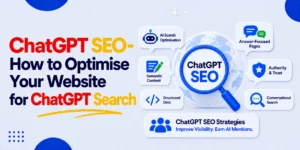



People now use ChatGPT to research products, compare services, find brands, and get direct answers. This shift makes ChatGPT SEO important for businesses that want to stay visible beyond Google. The goal is to make your website easy for ChatGPT to discover, understand, reference, and cite.
Strong ChatGPT search optimisation starts with crawlable pages, clear answers, relevant titles, original research, fresh information, and credible brand mentions. Businesses should also strengthen traditional SEO, use suitable structured data, and track referral traffic from ChatGPT. With the right ChatGPT SEO approach, your content can reach people during conversational searches and create another valuable source of website discovery.
Want Results Like These for Your Business?
Get a free site analysis from BThrust Malaysia and find out what's holding your SEO and traffic back.
What Is ChatGPT SEO?
ChatGPT SEO is the process of improving a website so ChatGPT can discover its pages, understand their purpose, and use them as sources when answering relevant questions. It builds on many familiar SEO principles, but the end goal extends beyond earning a high position on a traditional search results page.
Traditional SEO focuses on areas such as rankings, organic traffic, clicks, backlinks, and conversions. ChatGPT SEO adds another important goal- earning visibility inside conversational answers. A user may never browse ten search results if ChatGPT already gives them a useful response with a handful of supporting sources.
This makes SEO for ChatGPT valuable for brands that publish guides, product information, comparisons, research, industry insights, or educational resources. When your content gives a clear answer and backs it with useful evidence, it has a stronger foundation for search-driven discovery.
How Does ChatGPT Find and Cite Websites?
ChatGPT can search the web when a question requires current or web-based information. Search responses may include citations and source links, which allow users to explore the websites behind an answer. OpenAI also gives publishers control over whether OAI-SearchBot can access their content.
However, allowing access does not guarantee a citation. Your page still needs to match the user’s question and provide information that supports a useful response. Research from Ahrefs covering 1.4 million prompts found a relationship between relevant page titles and citation selection. The study also found that standard web search supplied most of the cited URLs within its dataset.
This suggests that ChatGPT search optimisation should not replace traditional SEO. Instead, businesses should build on sound search practices while making content easier to understand, extract, verify, and reference.
How to Do ChatGPT SEO
If you want to understand how to do ChatGPT SEO, start with the foundations. There is no single switch that makes a page appear in an answer. Several elements work together, from crawl access and page structure to evidence, freshness, and wider brand visibility.
1. Let OAI-SearchBot Crawl Your Site
Your content needs to be accessible before it can become part of a search response. OpenAI advises publishers to allow OAI-SearchBot if they want their pages considered for ChatGPT search results, snippets, summaries, and links. Review your robots.txt file and make sure important pages are not blocked by technical settings.
Your technical review should cover-
- robots.txt rules and crawler access
- accidental noindex tags
- broken pages and server errors
- incorrect canonical tags
- long redirect chains
- XML sitemap coverage
Your firewall or CDN can also block crawlers even when robots.txt allows them, so check the full path to your content. Strong crawl access creates the technical base for ChatGPT SEO optimisation and prevents valuable pages from disappearing behind avoidable barriers.
2. Answer Real Questions on Each Page
People often speak to ChatGPT in complete questions rather than typing two or three keywords. Someone may ask, “Which CRM works well for a small sales team?” instead of searching for “best CRM software”. Your content should reflect this shift in search behaviour.
Build pages and sections around genuine customer questions, then answer each question with enough context to solve the problem. A SaaS company can cover pricing, integrations, setup, security, use cases, limitations, and comparisons. Place the core answer near the start of the relevant section, then support it with examples, facts, or practical steps. This approach helps readers while strengthening SEO for ChatGPT.
3. Write Titles That Match Search Intent
A vague title may sound creative, but it can hide the true purpose of a page. Clear titles tell readers and search systems what information they will find before they open the page.
Instead of writing a title like “Everything Is Changing- What Comes Next?”, choose something more specific, like “Email Marketing Trends for SaaS Companies in 2026”. The second version identifies the topic, audience, and time period without forcing anyone to guess.
Ahrefs’ citation research found a relationship between title relevance and citation selection. This does not mean that adding keywords to a title guarantees a citation, but it shows why descriptive titles deserve a place in your ChatGPT SEO optimisation techniques.
4. Make Every Important Claim Easy to Extract
Long blocks of text, vague wording, and complicated sentences can hide useful information. Give each section a clear purpose and arrange ideas in a logical order. Use descriptive H2 and H3 headings, moderate paragraph lengths, lists when they help, and tables when readers need to compare several items.
When you make an important claim, explain what it means and support it where possible. Avoid stretching a simple point across several paragraphs just to increase word count. Clear content allows readers to grasp the answer faster and makes important facts easier to identify within the page.
5. Add Original Information Worth Citing
If your article repeats the same information found on dozens of websites, it gives search systems little new value. Original information can make a page more useful because it adds evidence that other sources may not provide.
Consider publishing-
- original surveys or research findings
- customer or product usage data
- expert comments and first-hand insights
- case studies with clear results
- industry benchmarks and comparisons
- practical tests, templates or examples
This approach matters when learning how to get cited in ChatGPT. A SaaS company might publish trends based on anonymous product usage, while a digital marketing agency could share campaign benchmarks from its own projects. Original information gives other websites and search engines a reason to reference your work.
6. Keep Important Content Fresh
Content that is outdated can quickly lose its value. This is especially true for content that covers software features and pricing, statistics, products, laws, and industry trends. You should create a schedule to review your website’s content and update it as needed.
Replace old statistics, remove dead links, update screenshots, refresh examples, and correct claims that no longer reflect the current situation. Bing also recommends IndexNow as a way to notify participating search engines when URLs change. Content maintenance should form a core part of your ChatGPT SEO strategy 2026, rather than becoming a task you tackle only when traffic drops.
7. Use Structured Data Where It Fits
Structured data gives search systems extra context about the information on a page. Schema.org markup can describe articles, products, organisations, events, FAQs, local businesses and several other content types.
Structured data should be implemented only when it matches the information users can view on the webpage. Do not add unrelated schema in an attempt to gain more visibility. Search engines recognise JSON-LD and Microdata as valid Schema.org formats, but web pages with structured data do not get special search engine results. The system functions to enhance your content understanding instead of serving as a quick method to obtain citations.
8. Build Brand Mentions Beyond Your Website
Your own website should not be the only source talking about your business. Industry publications, partner websites, interviews, directories, reviews, comparison articles and useful community discussions can expand your brand footprint across the web.
Ahrefs analysed 75,000 brands and found a strong correlation between branded web mentions and visibility across conversational search platforms. Correlation does not prove that mentions cause visibility, but it shows why a broad and credible web presence deserves attention. This principle supports both AI SEO and traditional brand-building efforts.
9. Strengthen Your Existing Search Performance
Do not treat ChatGPT search as a separate world. Technical SEO, helpful content, strong internal linking, relevant backlinks, descriptive titles, and clean website architecture still support discoverability.
For businesses working on SEO in Malaysia or AI SEO in Malaysia, this means existing search efforts can also contribute to visibility within conversational search. Instead of creating two separate content systems, improve the quality and clarity of the pages you already want customers to discover. Strong foundations can support traditional rankings and new search experiences at the same time.
10. Track ChatGPT Referral Traffic
Optimisation becomes more useful when you can measure what happens after making changes. OpenAI states that referral links from ChatGPT include utm_source=chatgpt.com, which can help publishers identify visits that come from ChatGPT search.
Track metrics such as-
- landing pages receiving ChatGPT referrals
- conversions from ChatGPT visitors
- engagement on cited or visited pages
- pages gaining visibility for key topics
- questions where competitors appear instead of your brand
Do not focus on traffic alone. A small number of highly relevant visitors who request a demo, join a trial, or contact your team may hold more value than thousands of low-intent visits. Measuring outcomes turns ChatGPT SEO into a business activity rather than a guessing exercise.
How to Optimise Website for ChatGPT Without Affecting Google SEO
You do not need to replace your existing SEO strategy when learning how to optimise your website for ChatGPT. Focus on improving content quality while keeping proven Google SEO practices in place.
- Improve Key Pages- Refresh your strongest pages with clear, accurate, and useful information.
- Use Clear Titles- Write descriptive titles that match the topic and search intent.
- Strengthen Internal Links- Connect related pages to help users and search systems find useful content.
- Add Original Value- Include research, examples, data, or expert insights that make your content worth referencing.
- Fix Technical Issues- Check crawl access, broken links, indexing problems, and structured data.
- Avoid Keyword Stuffing- Write for real questions instead of repeating keywords or creating thin pages.
These steps support ChatGPT SEO optimisation while protecting the SEO foundations that help your website perform in Google.
What Should Your ChatGPT SEO Strategy Focus On?
A practical ChatGPT SEO plan should focus on three areas: discovery, relevance, and credibility. Search systems need access to the page; its content must match the user’s question, and the information needs enough value to support an answer.
Technical SEO and content quality must work together. If your company provides ChatGPT SEO services, avoid promising guaranteed citations because no publisher can control which source ChatGPT chooses. Focus on crawl access, content quality, evidence, brand visibility and measurable referral performance instead.
Conclusion
Search habits are changing, giving businesses a new way to reach people beyond traditional search engines. Strong ChatGPT search optimisation helps your content become easier to discover, understand and reference.
To create effective ChatGPT SEO content, it is essential to focus on providing clear answers to users’ questions. Additionally, the content should have relevant titles, offer original insights and fresh information, and present the information in a simple and easy-to-follow structure. These practices improve the user experience and enhance the effectiveness of AI SEO.
For marketers, businesses, content creators, and SaaS companies, the best way to leverage ChatGPT for SEO is to focus on answering real questions from users, building trust with the audience, and publishing content that provides significant value to those searching for solutions.